Projects

Each page covers one project: the problem, the method step by step, the results, and what I learned. Numbers are from internal measurements; where a result holds only for a specific model or configuration, the page says so.

model families and their quantization difficultiesABOUT 19 PRODUCTION MODELS FALL INTO 8 FAMILIES, EACH WITH ITS OWN QUANTIZATION DIFFICULTYMonocular 3D detectionall-conv backbone, keypoint headsDIFFICULTYINT8 is nearly lossless; watchoutput bit-widths and underflow inmixed-precision trainingFront-view multi-task 2Dconv backbone, query-based headsDIFFICULTYTopK, deformable sampling,LayerNorm, Softmax: mixedINT8/INT16 plus two-stagedistillationLiDAR detection, segmentationpillar encoding, BEV convolutionsDIFFICULTYscatter cannot run in fixed point, soit is rewritten as a gather; a 1-LSBinput change flips outputsDriving occupancycameras and LiDAR, grid projection,temporal memoryDIFFICULTYsampling grids need INT16; feedingthe hidden state back requiresequal input and output scalesVector mapBEV features, several query polylinedecodersDIFFICULTYINT16 activations in the decoders;softmax rewritten as piecewiseLUTs; latency driven by nodecount, not FLOPsSparse 4D detection, trackinginstance queries, deformablesampling, cross-frame instancesDIFFICULTYall-INT16 decoder; fixed scale onthe projection divide; many LUToperatorsPrediction and planningstructured inputs, multi-steptrajectory generationDIFFICULTYwhole-graph INT16; errorcompounds through depth anditerations, so full QAT is requiredEnd-to-end planningperception to planning in one modelDIFFICULTYsmall numeric differences growover time: large-scalequantization-aware distillationagainst float
About 19 production models fall into 8 families, each with its own quantization difficulty: quantization is not the same job done 19 times.
0.217 LSBweighted mean error over 600 LUT modules

Adaptive lookup tables for non-linear operators

QCraft · 2026

An error-driven segmentation algorithm for fixed-point lookup tables. It refines segments only where the real fixed-point error is high, guaranteeing a 2 LSB worst-case error with 12–30 tables per operator instead of a uniform 126.

Read the details →

12stage-to-stage checkpoints, camera data to on-board output

Layered numerical consistency and release gates

QCraft · 2024 – 2026

A method that compares every stage of the deployment chain, from vehicle data to on-board post-processing, with the stage before it on identical inputs, so a mismatch has exactly one possible source. Plus evidence-graded release gates that keep unverified results off the car.

Read the details →

6stages in one pipeline, with an identity manifest running through it

A quantization-deployment platform: one truth, one contract, block by default

QCraft · Nov 2026 onward

Once the quantization framework worked, what remained was precision chosen by hand, errors that were hard to locate, and training that did not line up with deployment. This is the target architecture I led: the fixed-point model as the single source of truth, versioned contracts between training, conversion and the vehicle, and a blocking gate at every hop. It is a design draft.

Read the details →

0.7%error, 19.38 ms predicted vs 19.25 ms measured

Predicting on-board latency before writing code

QCraft · 2025 – 2026

A block-level latency model, calibrated on the board, that predicted an enlarged occupancy model within 0.7%. It ranked six deployment options before any code was written and led to a backbone shared by five perception models.

Read the details →

5 → 1image encoders (backbone + neck)

OneModel: five perception tasks on one shared vision encoder

QCraft · 2026

Merging the image backbone and neck of five perception models into one: how the latency budget works out, how the new backbone was sized, how its pretraining weights were synthesized from released models, and the end-to-end design that follows. Work in progress.

Read the details →

4,273production model conversions

QNN Web, one-click model conversion for every chip

QCraft · 2022 – 2026

An internal service that turns one uploaded model into engines for every target chip. Built in 2022–2023 to remove manual, error-prone conversions; rebuilt in 2026 for reliability and given an MCP interface so AI agents can drive it.

Read the details →

350 TOPStarget chip, J6M class

Urban NOA on a new chip (AXERA M95)

QCraft · 2026

Technical lead for porting QCraft's urban navigate-on-autopilot stack to a new chip family: a staged bring-up from a 700-TOPS demo board to the 350-TOPS M95, model adaptation and quantization, and road-test issue clustering. The v4 stack runs on test vehicles.

Read the details →

> 0.999output cosine similarity, INT8 vs float

TensorRT INT8 for cloud GPU models, and onnx2trt

Tencent Maps · 2021 – 2022

An INT8 quantization and deployment pipeline for Tencent Maps' cloud GPU models: cosine similarity above 0.999 to float, latency −20%, GPU utilization and memory −10%, and roughly ¥3M saved in compute. The calibration tooling became the open-source onnx2trt.

Read the details →

AR navigation perception SDK

Tencent Maps · 2021 – 2022

A perception SDK for AR navigation on phones and car head units: a multi-stream parallel framework with automatic profiling. 12 features delivered in four months with CPU usage under 70%, shipped on the JMC CX743 production vehicle.

Read the details →

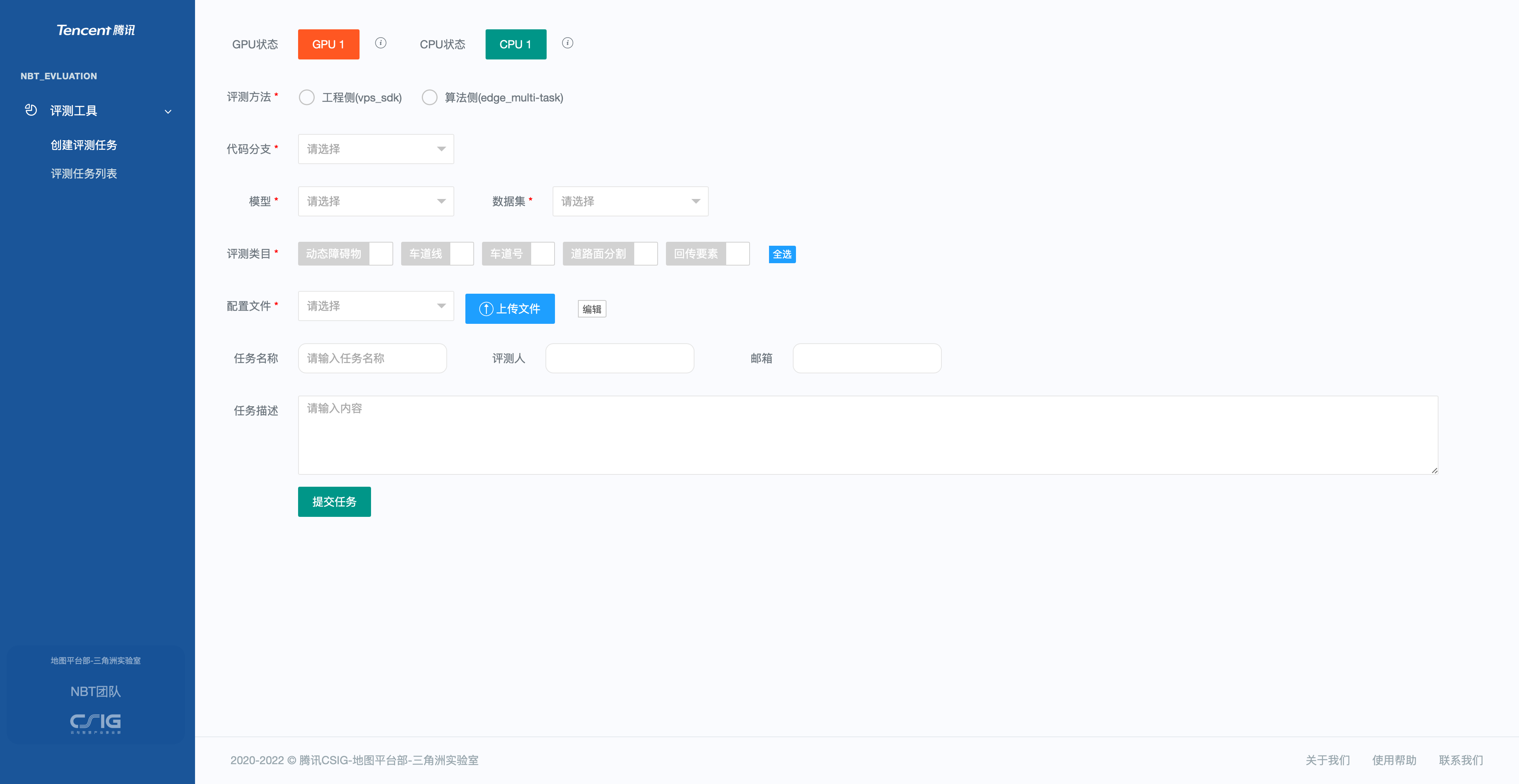
NBT evaluation platform

NBT evaluation platform

Tencent Maps · 2021 – 2022

An internal web platform for model and data management, evaluation runs, result tracking and data sharing, designed with interfaces for bad-case analysis, returned-data management and map-building visualization.

Read the details →